

You might be watermarking client proposals, branding marketing PDFs, or securing confidential files. You need a tool that works instantly without desktop software or bloated menus full of features you will never use.
The wrong tool wastes your time. You re-upload files. You fight confusing interfaces. Or you find out your free plan caps you at two documents per day.
We tested browser-based and desktop watermarking platforms. We looked at batch processing speed, customization options, and pricing transparency. Below are the ranked tools based on actual functionality, clear pricing, and documented history. Not on marketing budgets or generic feature lists.
Why PDF Watermarking Tools Matter
PDF watermarking tools solve two problems: proving ownership and keeping branding consistent.
When proposals, contracts, or creative work get shared via email or the cloud, a visible watermark stops people from redistributing without credit. It also shows who made the file.
Two types exist. Browser-based tools work fast for small batches, but upload speeds can slow you down. Desktop apps handle files locally. Slower to set up, but better for confidential or bulk jobs.
Who uses them? Photographers, creators, small businesses, and educators. Lately, compliance teams and real estate agents have joined in, too—mostly for audit trails and branding.
Buyers care about three things. Batch processing (50+ PDFs without re-uploading). Customization (font, opacity, placement). And clear pricing. Tools that hide costs behind “request a quote” or cap you at 2 files per day lose trust fast.
How to Choose a PDF Watermark Tool
Weigh these criteria before you commit:
- Founded year & track record – Tools from before 2010 have proven infrastructure. Newer ones ship features faster but risk abandonment.
- Cloud vs desktop – Browser tools send files to servers. Desktop apps work locally. Pick local for confidential contracts or client data.
- Batch limits – Free tiers: 2–10 files per day. Paid plans: hundreds of documents in one go.
- Customization – Look for text positioning, opacity sliders, logo resizing, and multi-page placement. That’s what pros use.
- Integrations – Direct cloud storage support saves time for teams already using Google Drive or Dropbox.
Online PDF Watermark Editor
Adding watermarks to PDFs is a standard way to protect your documents before sharing them. Below are five reliable online and desktop tools, each suited for different workflows and privacy requirements.
Watermarkly
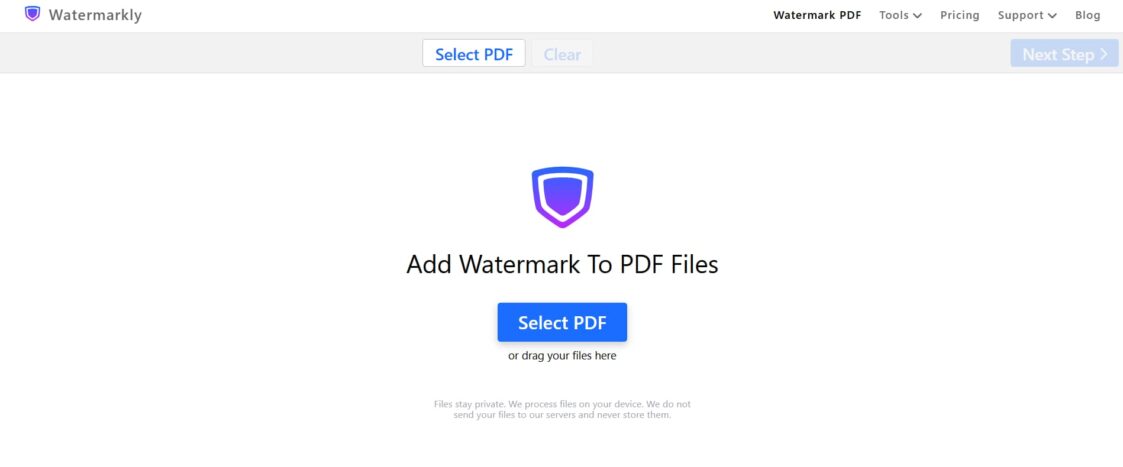
Watermarkly is an online tool for watermarking images, videos, and PDFs. Speed and simplicity are the priorities. It’s used by photographers, content creators, small business owners, handmade artists, real estate agents, educators, bloggers, and designers. Basically, anyone who needs to protect visual assets or brand documents without learning complex software.
You can create a watermark in three clicks. No nested menus. Upload your PDFs, pick text or a logo, drag to adjust size and placement, then export. Batch watermarking handles hundreds of files at once. If you’re watermarking client deliverables or portfolio PDFs every week, that saves a lot of time.
Other tools included: photo resizing, conversion, compression, and blurring. The blur tool helps redact license plates or faces in real estate photos before public sharing. The platform works in 20 languages on the web and mobile. It also has a 4.9 Trustpilot rating with over 2,500 reviews.
Pricing
- Free Version: Free, but adds “Watermarkly” logo to processed images.
- 1-Year Access: $19.95/year. Includes full access and removes branding.
- Lifetime Access: $39.95 (one-time fee). Best value for long-term users.
Weakness: No publicly documented REST API for workflow automation, which may limit integration into larger document-processing pipelines.
Smallpdf
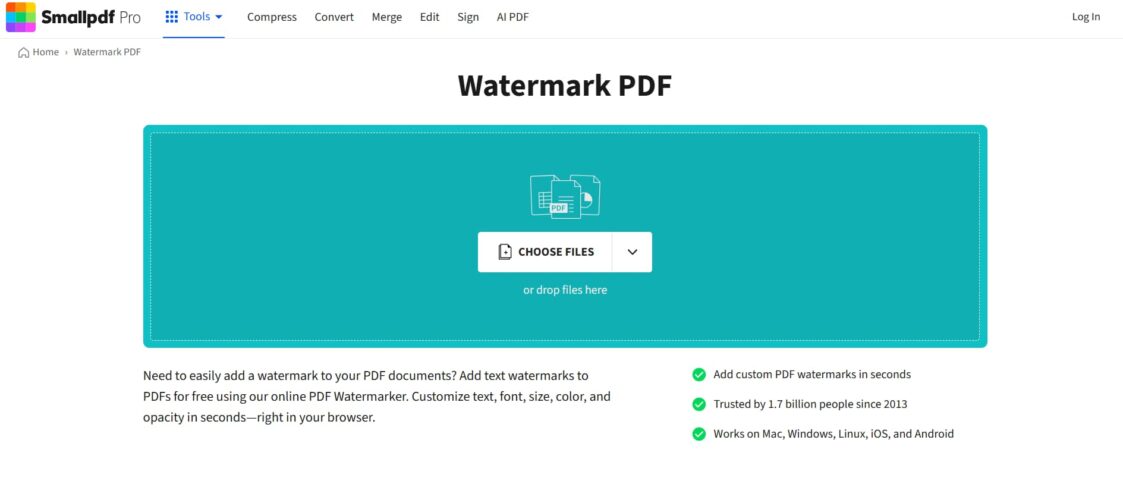
Smallpdf puts all the basic PDF tools in one place. Watermarking sits alongside 30+ other features — merge, edit, PDF to Word, sign — you get the idea. More than a billion users have used it. That kind of scale means the infrastructure is solid. But it’s also a generalist product, not a specialized tool.
Watermarking is straightforward. Upload a PDF. Click “Add Watermark.” Type text or upload a logo. Adjust transparency and position. Then download. It works with Google Drive and Dropbox too, so you can pull files from the cloud and save them back without leaving your browser.
Where Smallpdf shines: workflow continuity. If your team already uses Smallpdf to compress, merge, or convert PDFs, adding watermarking costs nothing extra beyond the Pro subscription you’re already paying. Unlimited access to all tools means no per-feature metering—you watermark 10 PDFs, then immediately compress 50 more without switching platforms.
Pricing tiers
- Free: Limited access to 21 tools, up to 2 conversions per day
- Pro: Unlimited access, offline desktop app, mobile app (contact for pricing)
- Pro for Teams: Volume discounts, priority support (contact for pricing)
Pros & cons:
| Strengths | Weaknesses |
| 30+ tools in one subscription | Pricing details require a contact-sales inquiry |
| Direct Google Drive/Dropbox integration | Watermarking is not the primary focus—lacks advanced batch controls vs dedicated tools |
Sejda
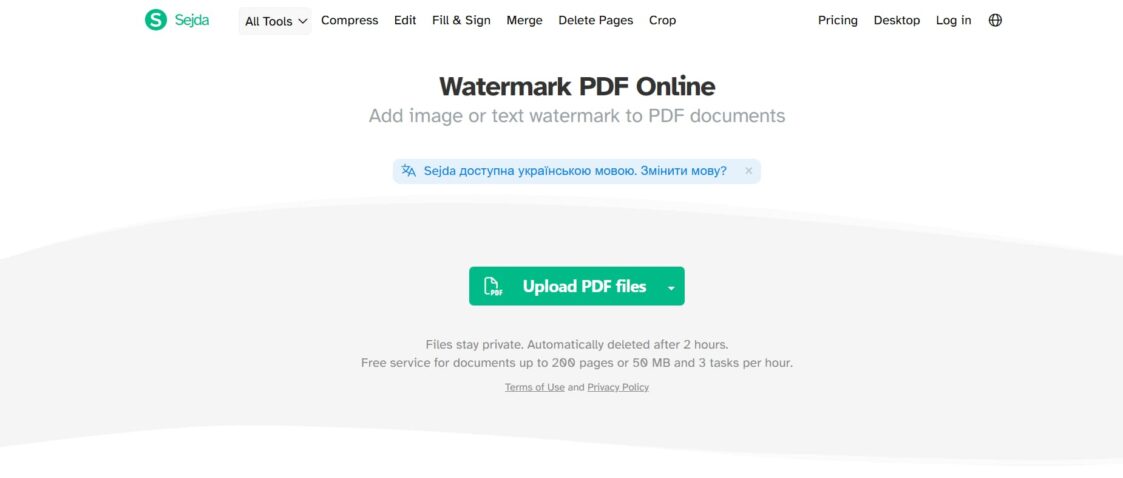
Sejda is an easy and productive PDF editor. You can use it online or offline—cloud version or desktop app. It’s for businesses and individuals who want flexibility. Some files go to the cloud for speed. Others, like confidential documents, stay local.
With the desktop version, files never leave your computer. So if you’re watermarking contracts under GDPR, HIPAA, or attorney-client privilege, no third party sees the content. The desktop app has the same features as the web interface: edit PDFs, password protect, compress, and OCR.
The watermarking tool is inside the main PDF editor. Open a document. Click “Add Watermark.” Type text or upload an image. Then set opacity, rotation, and per-page placement. There are 30+ PDF tools total. So you can watermark, then merge, compress, or OCR the same file without switching apps.
Pricing snapshot:
- Web Week Pass: $5 for 7 days with access to Sejda Web
- Web Monthly: $7.50/month with recurring billing for Sejda Web access
- Desktop+Web Annual: $63/year with access to both Sejda Web and Sejda Desktop
Weakness: The pricing structure is less intuitive than competitors—three separate SKUs (Web Week, Web Monthly, Desktop+Web Annual) require you to decide upfront whether you need local processing, which adds friction if you’re just testing the tool.
iLovePDF
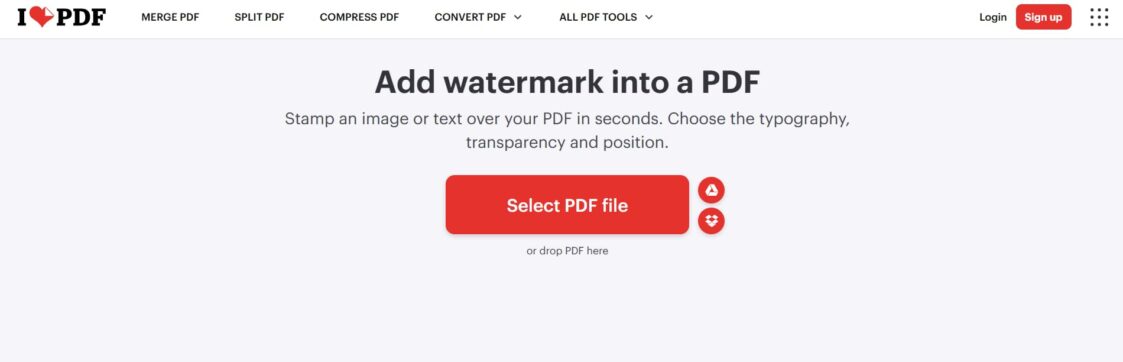
iLovePDF puts every PDF tool you need in one place. It’s 100% free and easy to use, with paid plans available if you need unlimited processing. The interface is available in more than 20 languages, which has made it a natural fit for non-English speaking markets and distributed teams.
The watermarking workflow follows the same simple philosophy. Upload a PDF, click “Watermark PDF”, then add text or a logo. Adjust size and transparency, then download. It also integrates with Google Drive and Dropbox, so remote teams can grab files from shared folders, watermark them, and return them without local downloads.
Here’s where iLovePDF stands out: predictable freemium economics. The free tier limits how much you can do, but it doesn’t lock features behind paywalls. You can watermark PDFs just fine—only not at scale.
Key features
- Merge PDF
- Split PDF
- Compress PDF
- Watermark PDF
- Edit PDF
Pros & cons:
| Strengths | Weaknesses |
| 20+ language UI—rare in PDF tools | Watermarking customization less granular than Watermarkly or Sejda |
| Transparent pricing | Free tier limits daily usage—impractical for regular batch jobs |
Visual Watermark
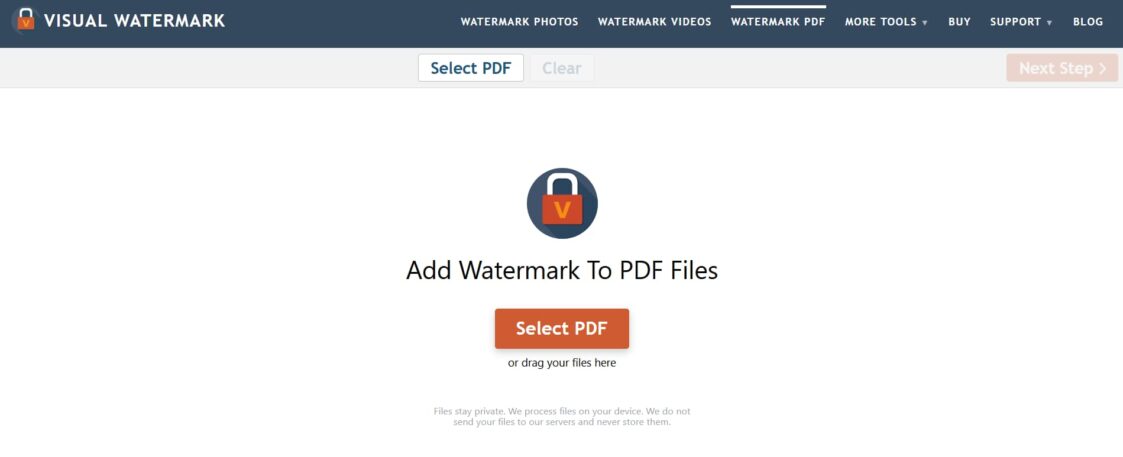
Visual Watermark is a solid, easy-to-use app for adding professional-looking watermarks to photos, videos, and PDF files. It’s been around long enough to have a proven track record—so you’re not dealing with some fly-by-night software.
Here’s the key part: everything runs right in your browser or desktop app. No files get sent to servers. That makes it the default choice if you’re watermarking confidential contracts, legal briefs, or medical records. Files never leave your machine, which removes the risk of a third-party data breach.
The desktop app handles batch watermarking for photos and PDFs. Its auto-size watermarks scale intelligently across different page sizes. You also get extra tools—add copyright metadata, resize pictures, rename photos. Photographers managing large portfolios will find that useful.
The interface is beginner-friendly. Drag-and-drop placement, real-time preview. No steep learning curve.
Notable capabilities
- Add text watermarks
- Insert logo watermarks
- Add watermark effects (shadows, outlines)
- Batch watermark photos
Weakness: No published pricing tiers documented in public-facing materials—you must download the app and check in-product pricing, which adds friction if you’re comparing costs across tools before committing.
Conclusion
Pick a tool based on two things: how sensitive your files are and how many you need to watermark.
Confidential contracts or client data? Use a desktop app like Sejda or Visual Watermark. Files stay on your computer.
Just need something fast and simple? Go with Watermarkly or iLovePDF. Batch processing works. Pricing is clear.
Avoid tools that hide pricing behind “contact sales” or limit you to 2 files a day. Those won’t work for regular use. That’s it. Match the tool to your privacy needs and volume. Ignore the rest.
